Chainmail armor was one of the most enduring defensive technologies of the ancient and medieval world. For centuries, warriors relied on interlinked metal rings, known as mail armor or Chainmaille, to provide flexible as well as reliable protection in battle. Among the most famous forms of chainmail shirts were the hauberk chainmail and the haubergeon chainmail, two closely related armors that varied in length, coverage and battlefield role.
Early Origins of Chainmail Armor
The development of chainmail armor dates back to the ancient world, with evidence suggesting its emergence around the 3rd century BCE. While often associated with Celtic craftsmanship, mail armor quickly spread across Europe and Asia due to its practical use. Roman legionaries adopted it widely, and its influence continued well into the medieval period. As trade routes expanded and military techniques evolved, different cultures refined ring construction, riveting methods, and garment shapes to suit regional warfare styles.
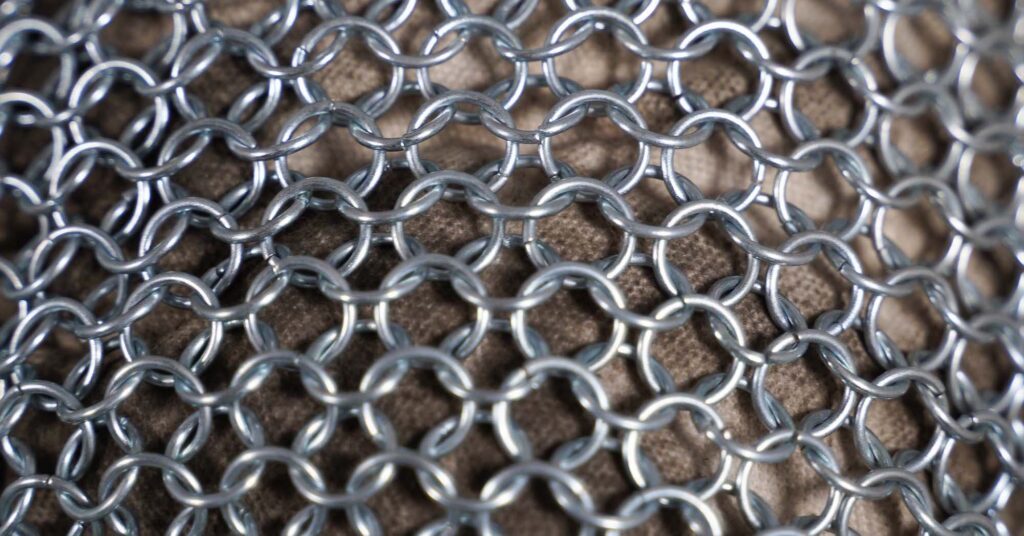
By the High Middle Ages, chainmail had become a foundational element of a knight’s equipment, often combined with padding and later integrated with emerging plate armor systems. Unlike rigid armor types, chainmail shirts were made from thousands of small metal rings linked together in a repeating pattern. This pattern distributed the force of slashing blows across a broader surface area while allowing excellent freedom of movement. Because of this balance between protection and flexibility, chainmaille remained relevant for over a millennium.
The interconnected ring structure also helped absorb shock and reduce localized damage, making injuries less severe compared to unarmored combat. Its breathable design allowed airflow during prolonged wear, which made chainmail suitable for extended campaigns, training, and varied climates across medieval regions, enhancing endurance and comfort during prolonged battlefield engagements and marches. Warriors valued chainmail for its durability, repairability, and adaptability across different combat roles. It could be worn alone or layered with padded garments, improving comfort and defense while maintaining mobility, making it a practical and trusted armor choice throughout medieval history.
Its modular construction allowed damaged sections to be repaired without replacing the entire garment, extending its lifespan considerably. This versatility enabled soldiers, guards, and knights to customize protection based on battlefield needs, climate conditions, and personal fighting styles, reinforcing chainmail’s long-standing popularity across cultures, armies, and evolving medieval combat traditions worldwide. By the early Middle Ages, mail armor had become a defining symbol of warriors and knights. It was adaptable, repairable by chainmail tools ,and effective against the weapons most commonly used in the warfare.
The Hauberk Chainmail : Full-Length Protection
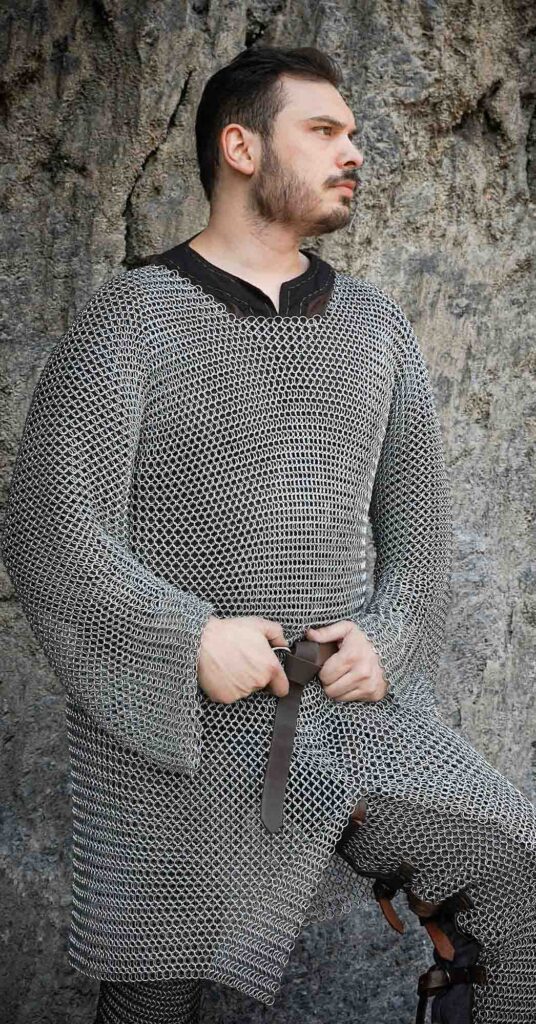
The hauberk chainmail emerged as the standard armor of medieval knights between the 11th and 13th centuries. Generally knee-length with long sleeves, the hauberk gave extensive coverage from shoulders to thighs. Many versions had front or side slits for horseback riding, for mobility without sacrificing protection.
Visually, the hauberk is one of the most recognizable forms of chain armor, famously depicted in period artwork such as the Bayeux Tapestry. It was often worn with a coif (mail hood) and chausses (mail leggings), which gave an almost full-body mail protection.
Because of its length and density, a hauberk could weigh between 10-15 kilograms depending on ring thickness and construction type. Despite this weight, the distribution across the torso made it surprisingly wearable when layered properly over padded garments. For centuries, it served as the primary defensive garment for knights before plate armor became popular.
Disadvantages of the Hauberk Chainmail
Although the hauberk chainmail gave more coverage, it was not without limitations. One of its primary drawbacks was its weight. A full-length hauberk could weigh over 10 kilograms depending on ring thickness and construction. While the weight was distributed across the body, wearing it for longer hours during battles could lead to fatigue.
Its length also affected mobility. Because the garment came to the knees, movement was somehow restricted when fighting in confined spaces or on uneven terrain. Some warriors preferred shorter chainmail shirts when agility was a priority.
Cost, Craftsmanship and the Time Required to Produce Mail Armor
Another significant disadvantage was cost and production time. Crafting a hauberk required thousands of individually linked metal rings, often alternating riveted and solid rings for strength. Producing high-quality mail armor demanded skilled labor and could take months to finish. As a result, a well-made hauberk chainmail was expensive and generally accessible only to wealthier knights and professional warriors. Maintenance also added to the long-term expense, as mail required regular cleaning, oiling, and repairs to prevent rust and damage. Broken rings had to be replaced by hand, meaning owners often relied on armorers for upkeep, further increasing the overall investment associated with maintaining functional chainmail armor.
The Haubergeon Chainmail : A Lighter Alternative
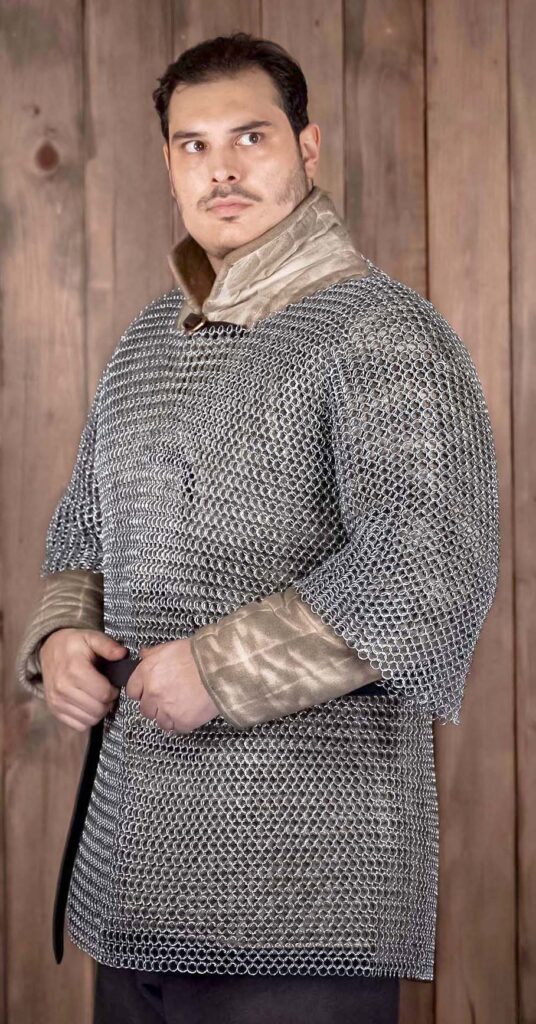
The haubergeon chainmail, which means “little hauberk” is a shorter and more practical version. Unlike the knee-length hauberk, the haubergeon extended only to mid-thigh or hip level. Sleeves were sometimes shortened to the elbow and some versions were even sleeveless.
This lighter construction made the haubergeon chainmail more versatile. It could be worn independently by foot soldiers or layered under additional armors. As warfare evolved and hybrid armor systems became common, shorter chainmail shirts were helpful as they combined mobility with protection. The haubergeon also showed technological and stylistic changes. As plate armor began to take over the mail armor, a shorter garment made logistical sense, for covering vital or vulnerable areas while the metal plates protected other areas.
Disadvantages of the Haubergeon Chainmail
The haubergeon chainmail, was lighter and more flexible but it came with its own disadvantages. Its shorter design gave less protection compared to a full hauberk chainmail. Areas of the upper legs and lower body were left more exposed, thereby increasing vulnerability. For more engaged battlefield roles, this reduction in protection was a critical factor.
Status, Wealth and Social Perception in Medieval Armor
In medieval culture, armor often showed status with practicality. A full-length hauberk was associated with higher-ranking knights and more wealth. The haubergeon chainmail on the other hand, was lighter and needed fewer materials, was sometimes viewed as a more modest option. While highly functional, it did not have the same visual authority or prestige as a complete suit hauberk.
Construction Methods and Materials
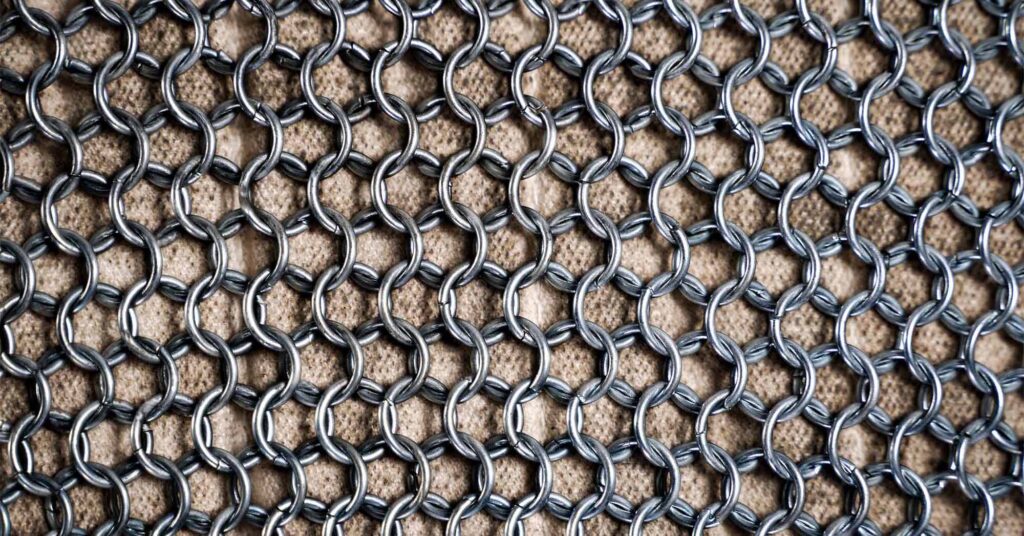
Traditional chainmail was constructed from iron or steel rings. High-quality mail often alternated between solid punched rings and riveted rings for better durability without adding unnecessary bulk. This pattern significantly improved resistance against ring separation under impact. Each chainmail shirt had thousands of individually assembled rings arranged in a 4-in-1 weave pattern, which means that each ring was connected to four others. This process allowed the armor to flex with body movement while keeping the structural integrity.
However, mail armor was not impossible to harm or damage. While highly effective against cuts, it was more susceptible to thrusting weapons and concentrated force from arrows or spears. For this reason, warriors wore padded underlayers such as gambesons. These textile layers absorbed blunt force trauma, preventing injury from impacts that mail alone could not fully take care of. The combination of padded garment and chain armor created a balanced defensive system that was effective for centuries.
Evolution and Transition to Plate Armor
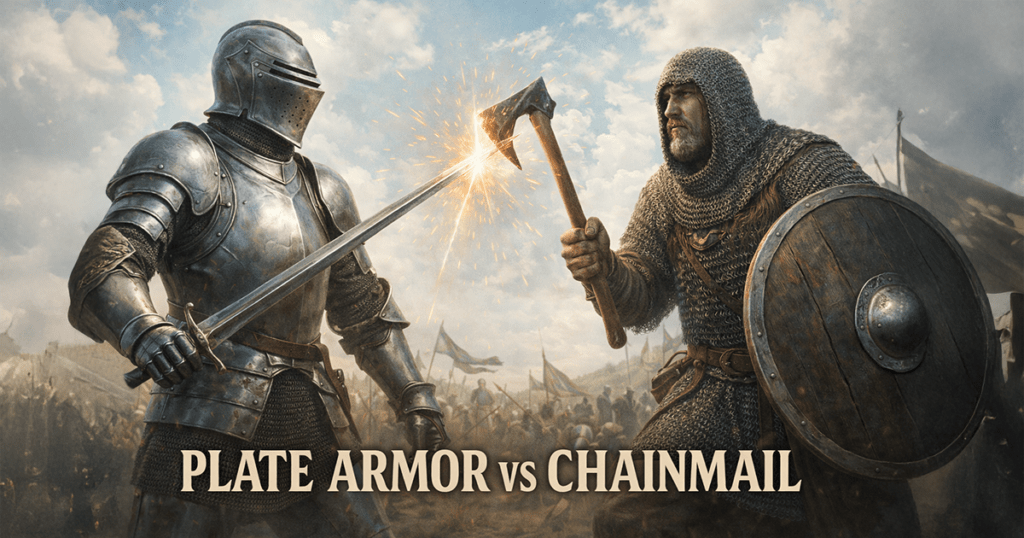
By the 14th and 15th centuries, advancements in metallurgy led to the more use of plate armor. Solid steel plates gave better resistance to piercing weapons and heavy blows. As a result, full-length hauberk chainmail gradually declined as the primary defensive armor. Even then, mail armor did not disappear. Instead, it evolved into a supportive role. Chainmaille was strategically placed at vulnerable joints, such as armpits, elbows and groin area, where rigid plates could not give the needed flexibility.
Importance
The long-lasting importance of hauberk chainmail and haubergeon chainmail comes from how easily they could adapt to different fighting styles and changing armor needs. They represent a transitional stage in armor development, bridging the ancient world and the high medieval period.
Frequently Asked Questions:
Q: What is chainmail?
A: Chainmail is a type of armor made from small metal rings that are linked together in a repeating pattern to form a flexible mesh. It was used in medieval times to protect the body from cuts and slashes while still allowing movement. Chainmail is typically worn as shirts, coifs, or gloves and is valued for its balance of protection, durability, and flexibility.
Q: When was chainmail invented?
A: Chainmail is believed to have been invented around the 3rd century BCE by the Celts in Europe. It later spread across different regions, including the Roman Empire and the Middle East, where it was widely used for armor due to its flexibility and strong protective qualities.
Q: What is a hauberk?
A: A hauberk is a type of medieval chainmail armor worn as a protective shirt. It is made from thousands of interlinked metal rings and usually extends to the mid-thigh with long sleeves. Hauberks were widely used by knights and soldiers in the Middle Ages to protect the body from cuts and slashes during combat.
Q: What is a haubergeon?
A: A haubergeon is a shorter type of medieval chainmail armor worn as a protective shirt. It is made from interlinked metal rings and usually reaches the waist or upper thighs with shorter sleeves than a hauberk.
Q: How to make chainmail armor ?
A: Chainmail armor is made by linking thousands of small metal rings together in a repeating pattern called a weave. Each ring passes through several others to create a flexible but strong metal mesh that protects the wearer from cuts and slashes.
Q: What is the difference between a hauberk and a haubergeon?
A: A hauberk is a longer chainmail garment that usually extends to the knees and has full-length sleeves, with greater protection for the body. A haubergeon is a shorter version that typically reaches the waist or upper thighs and may have shorter sleeves, making it lighter and allowing more mobility for the wearer.
Q: How much does chainmail weigh?
A: The weight of chainmail depends on its size, ring type, and the amount of coverage. A typical medieval chainmail shirt or hauberk usually weighs between 10-15 kg (22-33 lbs) when made from steel rings.